KSM66 - an updated security assessment (2025).
- Tom Johnsson
- Nov. 6, 2025
- 8-minute read
(Updated October 21, 2025)
KSM66 – one of the world’s most widely used herbal supplements and the world’s most widely used and well-documented ashwagandha.
This safety assessment was conducted in light of the questionable conclusions reached in a Danish risk assessment of ashwagandha (May 2020, DTU DOCX No. 19/1030299). A risk assessment that uncritically also forms the basis for the HoA report of June 2024 as well as a Dutch risk assessment RIVM2024–0029.
The following statement shows that the Danish risk assessment for ashwagandha is not applicable to KSM66.
Background: The Danish food authorities, in collaboration with DTU (Technical University of Denmark), have published a "Risk Assessment of Ashwagandha." In the report, they conclude that ashwagandha root may have adverse effects on sex and thyroid hormones.
This conclusion is mainly based on the fact that DTU uncritically assumed that root, leaf and stem contain the same active substances and that results from studies on leaf and stem can therefore be applied to root.
DTU's failure to understand the difference between different plant parts is confirmed in the introduction to the report where they write
”DTU has included experimental studies conducted using plant parts other than the root, as they share common ingredients. Withanolides and alkaloids are also found in other plant parts, and experimental studies using plant parts other than the root may therefore help shed light on the root’s potential effects. ”
DTU has not identified any risks associated with ashwagandha root
The report’s conclusions are particularly noteworthy because DTU has been unable to demonstrate any negative effects of ashwagandha root on either sex hormones or thyroid hormones. Of the 8 studies on the root (4 animal and 4 human) cited by DTU regarding the effect on sex hormones, seven show increased or normalized levels, while one animal study indicates reduced mating willingness after a dose 300 times higher than the standard dose. According to the article’s author, the reluctance to mate is likely caused by the high dose’s sedative effect—not due to a negative impact on sex hormones (Ilayperuma2002).
Correct conclusion regarding leaves
What DTU has shown instead, by referring to studies on leaves, stem and berries or the whole plant, is that these plant parts, in high doses, can have a negative impact on both sex hormones and on the liver. A known fact because above-ground parts contain high levels of withaferin A and withanone. Substances that are very potent (cytotoxic), and have a completely different side effect profile compared to roots.
Traditionally, therefore, only ashwagandharot is used
For the above reasons, it is always the root that has been used internally. One of the most common uses of Ashwagandharot is increased sexual desire and function. As a result, Ashwagandharot increases the body's resistance to stress, which indirectly contributes to the normalization of sex hormone levels. Topical parts of Ashwagandha have never been used in these areas - as they have partly the opposite effect - which DTU disregarded.
Indian health ministry advises against using leaves
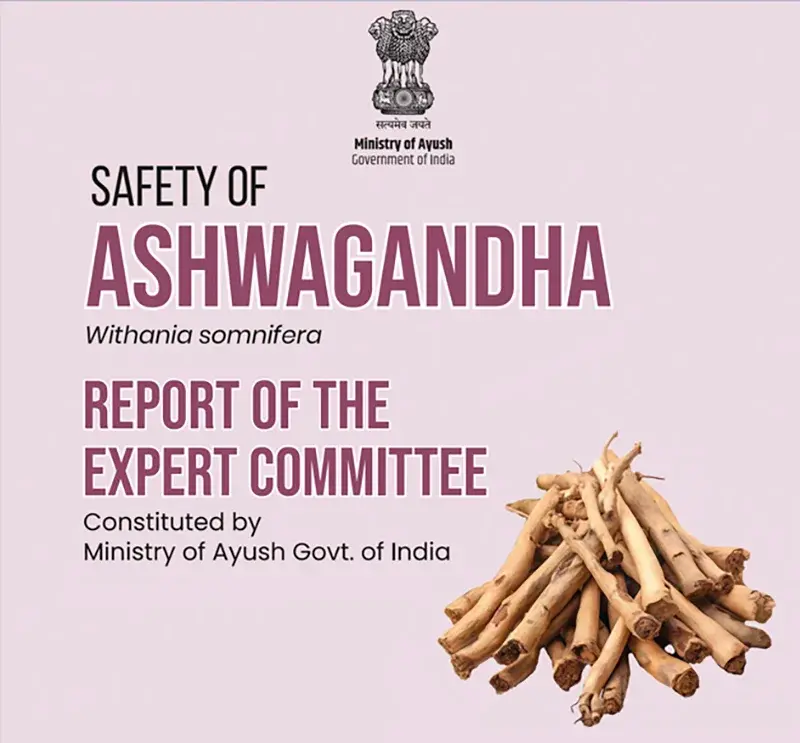
To clarify that only root should be used in food supplements/tea, the Indian Ministry of Health has published an official report advising against the use of plant parts other than root (2021).
DTU uses the wrong methodology
Dr. Senia Johanson PhD Pharmacognosy, Uppsala University comments on DTU's choice of methodology as follows (Safety evaluation on the root part vs.the entire plant/ aerial parts, March 2023):
"To determine the safety and efficacy of a herbal dietary supplement, it is important to conduct the safety assessment on the specific part of the plant used, in this case the root, which DTU disregarded. This is essential because the content of several substances, such as alkaloids, withanone and withaferin A, vary considerably between the root, leaf, stem and berries of ashwagandha."
Leaf and root analysis confirms the difference
Medfiles, a specialist in regulatory affairs, clinical trials, and drug safety https://medfilesgroup.com/published a report in March 2025 titled “Clarification on the differences in content of Withania somnifera(ashwagandha) roots and leaves.” This report has been submitted to the European Commission.
The report’s conclusion, which is based in part on an analysis by Alkemist Labs, Inc. (USA) (Dec. 2024), is summarized as follows:https://www.alkemist.com/
“Both HPTLC and HPLC techniques were used to analyze the differences in composition between the root and leaves of the same plant. The report shows that the amounts of withaferin A (cytotoxic) and withanolid A (the primary bioactive withanolid) differ significantly between the leaves and the root.”
Figure 2 shows that the content of withaferin A is much higher in leaves while withanolide A has a significantly higher concentration in root. In addition, a large difference in the amount of total flavonol glycosides was observed between the two plant parts.
The analyses show that the chemical composition of the root and leaves is very different. Consequently, the toxicological profiles of Ashwagandha root and leaves are also different.”

KSM66, one of the world's most widely used ingredients in food supplements - is unlike any other ashwagandha.
Green Chemistry: KSM66 is the only ashwagandha extracted using “Green Chemistry,” an eco-friendly method that took 14 years to develop. The method is based on a 3,000-year-old tradition that uses only milk and water. The raw material consists exclusively of organic ashwagandha root from our own certified farms. Ixoreal, the company behind KSM66, thus has 100% control from seed to finished extract.
The milk-and-water extraction method allows for the extraction of both water-soluble and fat-soluble compounds. The result is a full-spectrum extract that contains the same active compounds in the same natural proportions as found in the dried whole root. KSM66 is thus an exact replica of the preparation method that has been used traditionally for more than 3,000 years.
Withanone and Withaferin are not present in KSM66: KSM66 is the only commercially available ashwagandha root extract standardized on 6 withanolides. Each batch is checked for purity and active substances. The levels of Withanone (liver retardant) and withaferin A (cytotoxic) are below measurable values.
2.5 billion daily doses per year: KSM66 is the most widely used ashwagandha extract in the world and is found in over 4,000 different products outside of India. Annual consumption of KSM66 outside of India amounts to approximately 2.5 billion daily doses. No serious side effects have been reported.
1 million packages in Sweden: KSM66 was launched in Sweden in the fall of 2017 and has since been Sweden’s best-selling plant-based dietary supplement. The success is equally evident in Finland, where KSM66 was launched in 2018, and in Norway, where KSM66 was launched in 2019. In these three countries, approximately 400,000 packages are sold annually, which corresponds to approximately 24 million daily doses per year. No serious side effects have been reported.
The world's most well-documented ashwagandha - for efficacy and safety.
• 25 published clinical studies, one approved for publication. All studies were conducted on healthy, stressed men and women aged 15–75. Twenty-five of these are double-blind, placebo-controlled, and randomized.
• 13 clinical studies under review conducted on healthy, stressed men and women aged 15–75 (11 under peer review, 2 under internal review). 12 of the studies are double-blind, placebo-controlled, and randomized
29 of the clinical studies have been published/completed after DTU made its report.
• 15 preclinical/toxicological studies have been conducted of which 10 have been published, 2 have been accepted for publication, and 3 are under review. The majority of the studies were conducted at a dose corresponding to 200 times the normal dose (2000 mg/kg body weight). Acute toxicity, mutagenicity, long-term effects, and reproductive toxicity have all been studied.
All are published after DTU made its report
• In addition, 20 double-blindplacebo-controlled studies are currently underway.
Three new safety studies:
• 12-month safety study: The study was conducted under the direction of a U.S. CRO and is published in Phytotherapy Research. The study included participants from the U.S., Italy, and India.
Study summary: 191 people received 600 mg of KSM66 per day for 12 months. A wide range of liver, kidney, and thyroid values were monitored throughout the study. No clinically significant differences between baseline and end-point values were noted. However, both cortisol and testosterone levels normalized. 7 out of 10 participants experienced a clinically significant improvement in areas such as quality of life.
• Global safety study: The study included 1,000 men and women aged 15–65. The study was conducted under the direction of an American CRO and included participants from five continents. The study is currently under review and has been published as a preprint.
The authors of the study conclude that KSM66/Ashwagandha root extract is well tolerated and safe for adults to use (over 15 years). The adverse event rate in the KSM66 group was 5.6% versus 9.2% in the placebo group. All side effects were mild and transient.
• High-dose safety study with 2000 mg/day: 86 participants, men and women aged 18–65. Dose of 2000 mg KSM66 per day (just over 6 capsules) for 12 weeks. No clinically relevant effects on kidney, liver, hematological, or thyroid function were observed. The study is currently under review and has been published as a preprint.
Incidence of side effects: A total of nearly 4,000 people participated in the studies. In the KSM66 group, 3.81% of participants experienced side effects, compared to 4.77% in the placebo group. All side effects were mild and transient.
Focus on sex hormone, thyroid hormone and liver function.
Sex hormones: 13 studies have evaluated the effect on sex hormones in men and women. All studies show normalized/improved levels of sex hormones, sperm motility, etc. All values are within the normal range after taking KSM66.
8 of the studies have been published, one accepted for publication, 3 under per review and one under internal review.
11 of the studies are published/completed after the DTU report.
Liver function: 13 studies have evaluated liver function.
All studies show that KSM66 does not adversely affect any liver values. 8 of the studies are published, 7 under per review and one under internal review.
All are published/completed after the DTU report.
Thyroid: Five studies have evaluated the effect on the thyroid. Two involved subclinical hypothyroidism and three involved normal thyroid function. KSM66 does not affect a healthy thyroid but has a mild normalizing effect in subclinical hypothyroidism—a result of normalized cortisol levels. Three of the studies have been published; two are currently under review.
4 of the studies were done after the DTU report.
Two preclinical safety studies of particular importance
1. A 90-day toxicology study in 100 Wistar Albino rats (2023)
KSM66 was given at doses up to 2000 mg/kg body weight (200 times the normal dose) per day for 90 days (one tenth of the rat's life expectancy).
Results: No changes were observed in the test animals compared to the control group with regard to body weight, hematology, or biochemical parameters. There were also no changes compared to the control group with regard to thyroid hormones or liver function tests.
The study is published in Toxicology Reports.
2. Reproduction study in 92 Wistar Albino rats (2025)
40 male rats were divided into 4 groups and fed with 0, 500, 1000, 2000mg KSM66/kg body weight per day. Dosing started 24 days before mating and continued throughout mating.
52 female rats were divided into equivalent groups and given identical doses of KSM66 for 63 days starting before mating and throughout gestation and lactation.
Results: No abnormal clinical signs of toxicity were observed in either the adult rats or their offspring during the study. No significant changes were observed in body weight, food consumption, estrus, mating behavior, weight, anogenital distance, hormone levels, organ weight, or histopathology in the treatment groups compared to the control group. No statistically significant changes were observed in TSH and T4 levels for males, females, or their offspring compared to the control group.
The study is published in Frontiers of Pharmacology.
Three comprehensive reports from 2024 underline the safety of KSM66 and that the DTU risk assessment is not applicable to KSM66.
1. Expert opinion regarding “Expert Opinion on the Safety Evaluation Studies with Ashwagandha (Withania somnifera) Root Extract KSM-66 as a Food Supplement” by Professor Matti Johannes Viluksela, Ph.D., DABT, ERT. Nov 2024
2. Safety Assessment “Summary of safety data on KSM-66® Ashwagandha, including comments on the DTU National Food Institute’s risk assessment report on ashwagandha/Withania somnifera” by Pia Karjalainen, M.Sc., Senior Regulatory Affairs Expert, and Mari Lyyra, M.Sc., Head of Operations, Medfiles Ltd. DEC 2024
3. Ashwagandha safety with a special focus on the liver. Professor Emeritus Dr. Åke Nilsson, Lund University. May 2024
Professor MattiJohannes Viluksela, Ph.D conclusion is:
"There are sufficient safety evaluation studies (both preclinical and clinical) to indicate the safety of KSM-66. Overall, the safety evaluation of the ashwagandha extract KSM-66 is based on (1) experience from the long history of use of traditional water extracts of ashwagandha roots and (2) quality control of the production of KSM-66, (3) preclinical safety evaluation studies on KSM-66, and (4) assessment of safety parameters in clinical trials with KSM-66."
Summary.
- KSM66 has been included in a total of 39 clinical studies and 15 preclinical studies, of which 38 have been published or approved for publication while 16 are under review - in addition, 20 clinical studies are ongoing.
All journals are PubMed approved, which means that they are scientifically reviewed (peer-reviewed) and meet international standards.
- Nearly 4,000 men and women aged between 15 and 75 years were included in the studies, which together showed that the risk of experiencing an adverse reaction to KSM66 is comparable to placebo. All side effects have been mild and transient.
The majority of the clinical and preclinical studies did not exist in 2020 when DTU published its report.
In the report, DTU asks:
1. reproduction studies where animals were given ashwagandha continuously from mating to lactation
2. 90-day safety studies in animals.
3. long-term human study.
All these studies have now been completed at KSM66 - and published.
- In addition, Ixoreal has conducted a global, multicenter study of 1000 individuals and a high-dose study.
- KSM66 has been on the US market since 2013. 2.5 billion daily doses are consumed annually in 62 countries, 650 million of which are in Europe - making KSM66 one of the world's most widely used herbal supplements.
- In Sweden, more than 60 million daily doses have been sold since its launch in October 2017. No serious side effects have been reported with KSM66 in Sweden or in any other market.
- KSM66 is also one of the most certified food supplements in the world with 48 third-party certifications for traceability, environmental responsibility, safety and control. Certifications preferably issued by American, Korean and European certification bodies.
Finally: The City of Malmö’s Environmental Administration has reviewed the safety documentation for KSM66 and, based on this, has concluded that no restrictions regarding KSM66 are warranted.
Malmö 2025-10-21
Tom Johnsson, Founder, CEO, Quality Manager
MedicineGarden AB, tom@medicinegarden.se, 0705-94 91 95
The above is fact-checked by
Senior Physician, PhD Stefan Branth, Specialist in Internal Medicine and Clinical Nutrition, branthdr@gmail.com
All reports are available upon request.


Comments